
What is a Boundary? Why Are They Important with Toddlers?


Picture this: It's 6:47 PM, dinner is burning on the stove, and your two-year-old has just launched their third cup of water across the kitchen floor—again. You've asked them nicely to stop. You've tried distracting them. You might have even raised your voice a little (we've all been there). But here they are, grinning at you like they've just discovered the most entertaining game in the world.
Sound familiar?
Let's be honest, if you're reading this with a coffee that's gone cold three times already, you're probably wondering: "What am I doing wrong? Why won't my toddler just listen?"
Here's the truth that might surprise you: your child isn't being defiant. They're not "testing" you to make your life harder. They're actually doing exactly what their developing brain is designed to do: learn about the world through exploration, repetition, and yes, pushing against limits.
The problem isn't your toddler. It's that most of us were never taught what boundaries actually are or how to set them in a way that feels good for everyone involved.
What is a Boundary, Really?
When most parents hear the word "boundary," they think of rules, consequences, or that dreaded moment when you have to be the "bad guy." But boundaries aren't about control—they're about safety, security, and teaching.
Think of boundaries like the edges of a playground. They don't exist to stop children from having fun. They exist to create a safe space where children can explore, play, and grow without danger. Research consistently shows that children actually thrive when they have clear, consistent limits. It gives them a sense of security and helps them understand how the world works.
A boundary is simply a limit that protects something important—your child's wellbeing, your family's values, or the smooth functioning of your home. But here's what makes boundaries different from rules: a boundary is something you do, not something you ask your child to do.
Let me paint you a picture. When you say, "Please don't throw your toys," that's a request. When you calmly say, "I won't let you throw toys. I'm going to move them now," and then follow through, that's a boundary.
The difference? One puts the responsibility on your toddler's still-developing impulse control. The other puts the responsibility where it belongs, with you, the adult who has a fully developed prefrontal cortex and the ability to think ahead.
Why Do Toddlers Push Against Boundaries?
Before we dive into why boundaries matter so much, let's talk about why your little one seems determined to test every single limit you set. Spoiler alert: it's not personal, even though it feels that way at 7 AM when you're trying to get everyone dressed and out the door.
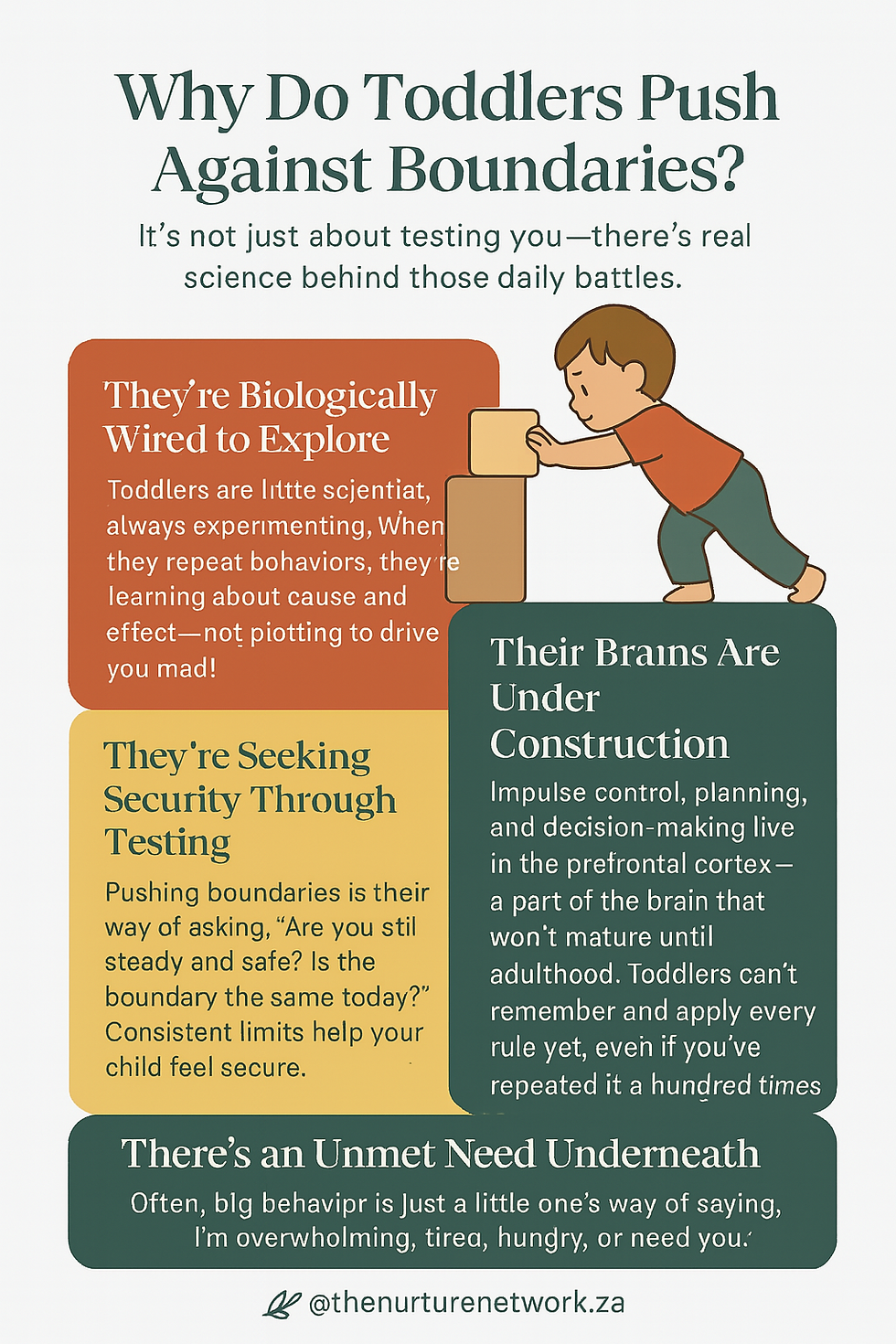
They're Biologically Wired to Explore
Toddlers are essentially tiny scientists conducting experiments all day long. When they throw that cup of water for the third time, they're not thinking, "How can I annoy Mom today?" They're thinking, "What happens if I do this again? Will the water still splash? Will Mom react the same way?"
By 16 months, toddlers use the left parietal cortex and both sides of the prefrontal cortex more extensively, but these brain regions are still developing rapidly. They're building neural pathways through repetition and testing cause and effect.
Their Brains Are Under Construction
Here's something that might make you feel better about those daily boundary battles: the prefrontal cortex in children shows gradual structural changes and children's protracted development of prefrontal-dependent skills. Translation? The part of your toddler's brain responsible for impulse control, planning, and decision-making won't be fully developed until their mid-twenties.
When your 18-month-old hits their sibling after you've told them "gentle touches only" fifty times, it's not defiance, it's development. Their brain literally cannot hold onto that information and apply it consistently yet.
They're Seeking Security Through Testing
Plot twist: when toddlers push boundaries, they're often looking for the boundary itself. They're asking, "Where's the edge? Is it the same today as yesterday? Are you still the steady grown-up keeping me safe?"
This is why inconsistent boundaries can actually increase testing behavior. If sometimes you follow through and sometimes you don't, your child's brain thinks, "I need to keep checking to see what's real today."
There's an Unmet Need Underneath
Sometimes boundary-pushing is your toddler's way of communicating something they can't put into words yet. Maybe they're overwhelmed, tired, hungry, or feeling disconnected from you. Their behavior becomes their language.
When my client Sarah's three-year-old started throwing massive tantrums every time she tried to leave the house, we discovered it wasn't about leaving—it was about transitions. Once Sarah started giving five-minute warnings and creating a visual schedule, the meltdowns virtually disappeared.
Why Are Boundaries So Important for Toddlers?
Now that we understand why toddlers test limits, let's talk about why holding those limits is one of the most loving things you can do as a parent.
Boundaries Build Emotional Security
Imagine trying to drive in a city with no road signs, traffic lights, or lane markers. You'd feel anxious, overwhelmed, and constantly on edge, right? That's what the world feels like to a toddler without clear boundaries.
When you hold limits consistently and calmly, you're creating predictability in your child's world. Their nervous system can relax because they know what to expect. They can focus on learning and playing instead of trying to figure out the rules.
Recent studies demonstrate that the impacts of early adverse environments on prefrontal cortex are present very early in development: within the first year of life. This means that the emotional environment you create through consistent boundaries literally shapes your child's developing brain.
They Support Healthy Brain Development
Here's where the science gets really fascinating. When you respond to your child's big emotions with calm, steady boundaries, you're actually helping their brain develop the neural pathways for self-regulation.
Until their brains mature, it is our responsibility to guide them (and 'lend' them our prefrontal cortex until theirs matures). You become their external regulator, showing them what calm, controlled responses look like until they can internalize those skills.
Think of it like teaching your child to ride a bike. You don't expect them to hop on and pedal away perfectly on the first try. You run alongside them, holding the seat steady, until their balance develops. Boundaries work the same way—you're the steady presence helping them develop emotional balance.
Boundaries Teach Life Skills
Every time you hold a loving boundary, you're teaching your child something valuable about how relationships work, how to respect others, and how to navigate the world. You're showing them that:
Words have meaning (when you say something, you follow through)
They are safe even when they're upset (you don't abandon them in their big feelings)
There are people who care enough to guide them (you're not their friend, you're their leader)
The world has structure and predictability (they can trust what you tell them)
They Build Connection, Not Distance
Here's something that might surprise you: boundaries actually strengthen your relationship with your child, not weaken it. When you hold limits with love and consistency, you become a safe harbor in their stormy emotional world.
Children don't need parents who say yes to everything. They need parents who can say no with kindness, who can stay calm when they're falling apart, and who love them enough to teach them what they need to know.
A Real Mom's Story: How Boundaries Changed Everything
Meet Emma, a mom from Cape Town who reached out to me when her 2.5-year-old son, Luke, was having daily meltdowns that left the whole family walking on eggshells.
"I felt like I was constantly negotiating with a tiny dictator," Emma told me. "Luke would ask for snacks twenty minutes before dinner, and when I'd say no, he'd scream for an hour. I started just giving him whatever he wanted to avoid the meltdown, but that made everything worse."
Emma had fallen into the common trap of thinking that boundaries would damage her relationship with Luke. She wanted to be the "yes mom," the fun mom, the mom who never made her child cry.
But here's what happened when we worked together to establish clear, loving boundaries:
Within two weeks of consistent follow-through, Luke's meltdowns decreased by 80%. He started accepting "no" with minor disappointment instead of major meltdowns. Most surprisingly to Emma, their relationship actually got stronger.
"I thought he'd hate me for setting limits," she said. "But the opposite happened. He started seeking me out for comfort when he was upset instead of pushing me away. It's like he finally trusted that I could handle his big feelings."
Luke is now three and a half, and while he still has moments of boundary-testing (because he's a normal toddler!), Emma feels confident in her ability to guide him with love and firmness.
"I was at my wit's end with my three-year-old's constant testing. Every day felt like a battle, and I was exhausted from the power struggles. When I started working with Ohara, I learned that boundaries weren't about being strict, they were about being loving and consistent. Within a month, our home went from chaos to calm. My daughter still tests limits (she's three!), but now I know how to respond in a way that feels good for both of us." - Sarah M., London
Conclusion: Boundaries Are Love in Action
Your toddler doesn't need you to be their friend. They need you to be their calm, confident leader who loves them enough to teach them what they need to know about the world.
When you set boundaries with love, you're not being mean or controlling. You're providing the gift of security, structure, and emotional safety. You're helping their brain develop the skills they'll need for the rest of their lives.
It won't always be easy. There will be tears (theirs and maybe yours). There will be days when you question whether you're doing the right thing. But trust the process, trust your instincts, and remember—you are exactly the parent your child needs.
If you're feeling stuck or need more personalized support for your unique situation, I'd love to help. Book a consultation call to discuss how we can work together to create more peace and connection in your home.
You've got this, mama. One boundary at a time.
Frequently Asked Questions About Toddler Boundaries
How early should I start setting boundaries with my child?
Boundaries can begin as early as 6-8 months, but they look different at different ages. For babies, boundaries might be gentle redirection or creating a safe environment. For toddlers, boundaries become more about clear limits and consistent follow-through. The key is matching your approach to your child's developmental stage.
What's the difference between boundaries and punishment?
Boundaries are about teaching and protecting, while punishment is about consequences and control. A boundary might sound like: "I won't let you throw toys. I'm putting them away now." Punishment sounds like: "You threw toys, so now you're in trouble." Boundaries maintain connection while teaching; punishment often creates shame and distance.
My toddler cries every time I set a boundary. Am I being too strict?
Tears are a normal part of childhood and don't mean you're being too strict. In fact, learning to experience disappointment in a safe relationship is an important life skill. Your job isn't to prevent all tears—it's to stay calm and connected while your child processes their big feelings.
How long does it take for boundaries to "work"?
Most families see significant improvement within 2-4 weeks of consistent boundary-setting. However, remember that toddler development isn't linear. You might see progress, then regression, then more progress. This is normal brain development, not a sign that boundaries aren't working.
What if my partner and I disagree on boundaries?
Consistency between caregivers is important, but it doesn't mean you have to parent identically. Have conversations about your core values and non-negotiable boundaries (like safety rules), then support each other even if your styles differ slightly. Children can adapt to different approaches from different caregivers.
Should I explain why I'm setting a boundary?
Simple explanations can be helpful for toddlers over 18 months, but keep them brief and age-appropriate. "We don't hit because it hurts" is better than a long lecture about empathy. Remember, your calm action is more important than your explanation.
What about boundaries in public?
The same principles apply whether you're at home or in public. The only difference might be your response to others' reactions. Your child's need for consistent boundaries doesn't change based on your location. Don't let fear of judgment prevent you from following through.
References
Nurtured First. (2024). Why Children Need Boundaries: A Guide For Parents. Retrieved from https://nurturedfirst.com/toddler/setting-boundaries-guide/
Raised Good. (2024). Toddlers, Meltdowns and Brain Development: Why Parents Need to Ditch Traditional Discipline. Retrieved from https://raisedgood.com/toddlers-meltdowns-brain-development-ditch-traditional-discipline/
Gabard-Durnam, L. J., et al. (2018). Rapid infant prefrontal cortex development and sensitivity to early environmental experience. Developmental Review, 48, 113-144.
Blasi, A., et al. (2024). Toddlers' brains show significant growth in cognitive skills by 16 months. Developmental Science.
Moriguchi, Y., & Hiraki, K. (2013). Prefrontal cortex and executive function in young children: a review of NIRS studies. Frontiers in Human Neuroscience, 7, 867.
Knudsen, E. I. (2004). Sensitive periods in the development of the brain and behavior. Journal of Cognitive Neuroscience, 16(8), 1412-1425.
Diamond, A. (2013). Executive functions. Annual Review of Psychology, 64, 135-168.


_edited_edited.png)
.png)